

Distributed Fiber Optic Sensing
Phosaris

Berlin
Brandenburg
Innovation Award
Winner 2025
Home / Phosaris
Distributed Fibre Optic Sensing – New Possibilities for Infrastructure, Geophysics and Environmental Monitoring
Using standard optical fibres as distributed sensors, PHOSARIS measures deformation and vibration continuously along the fibre — from very slow and quasi-static strain changes to dynamic signals in the kilohertz range. Nanometre-per-metre-scale strain sensitivity and metre-scale spatial resolution make small distributed deformation visible over kilometre-scale distances. This opens new possibilities for infrastructure monitoring, geophysics, early warning and long-term environmental observation.

Overview
What is Phosaris?
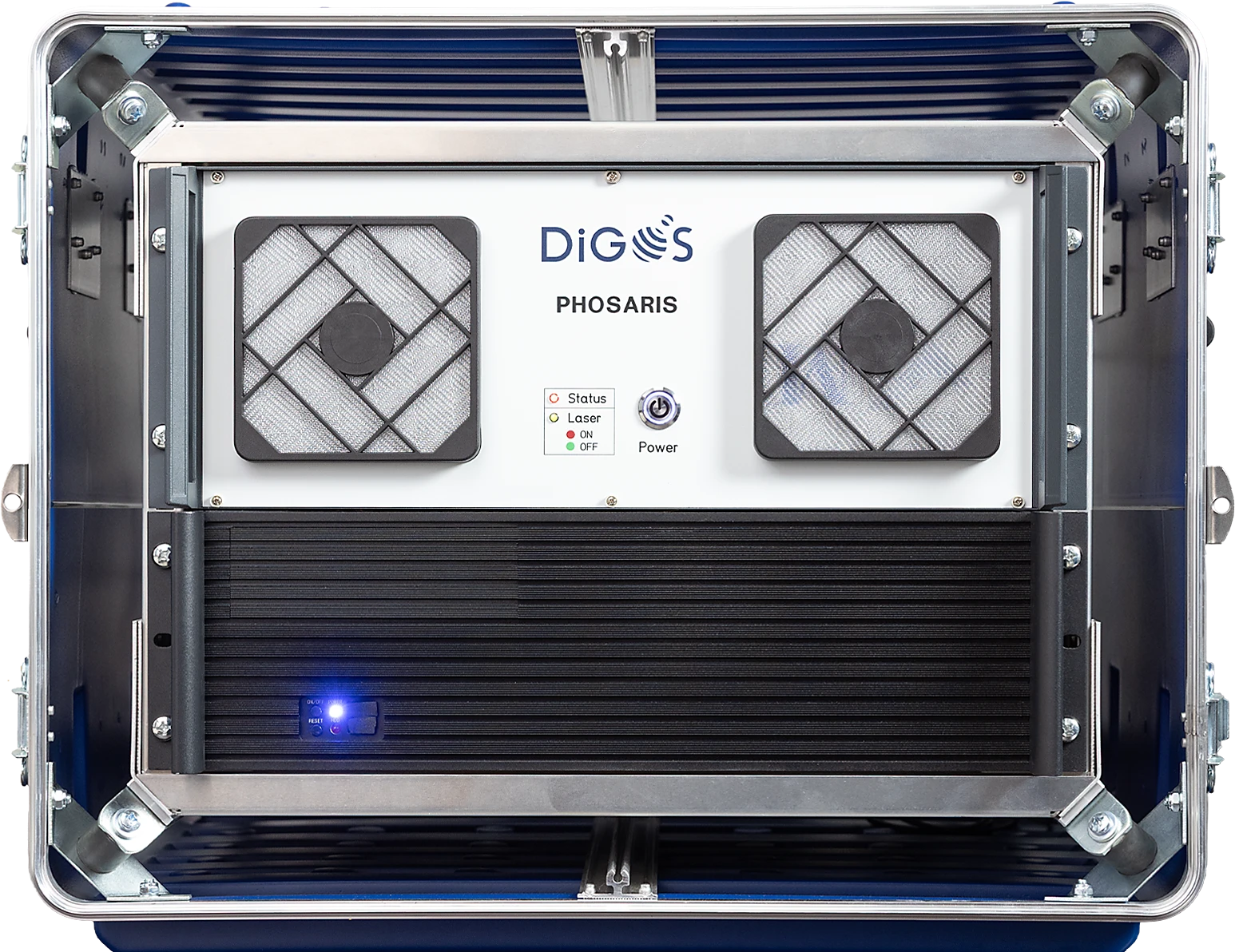
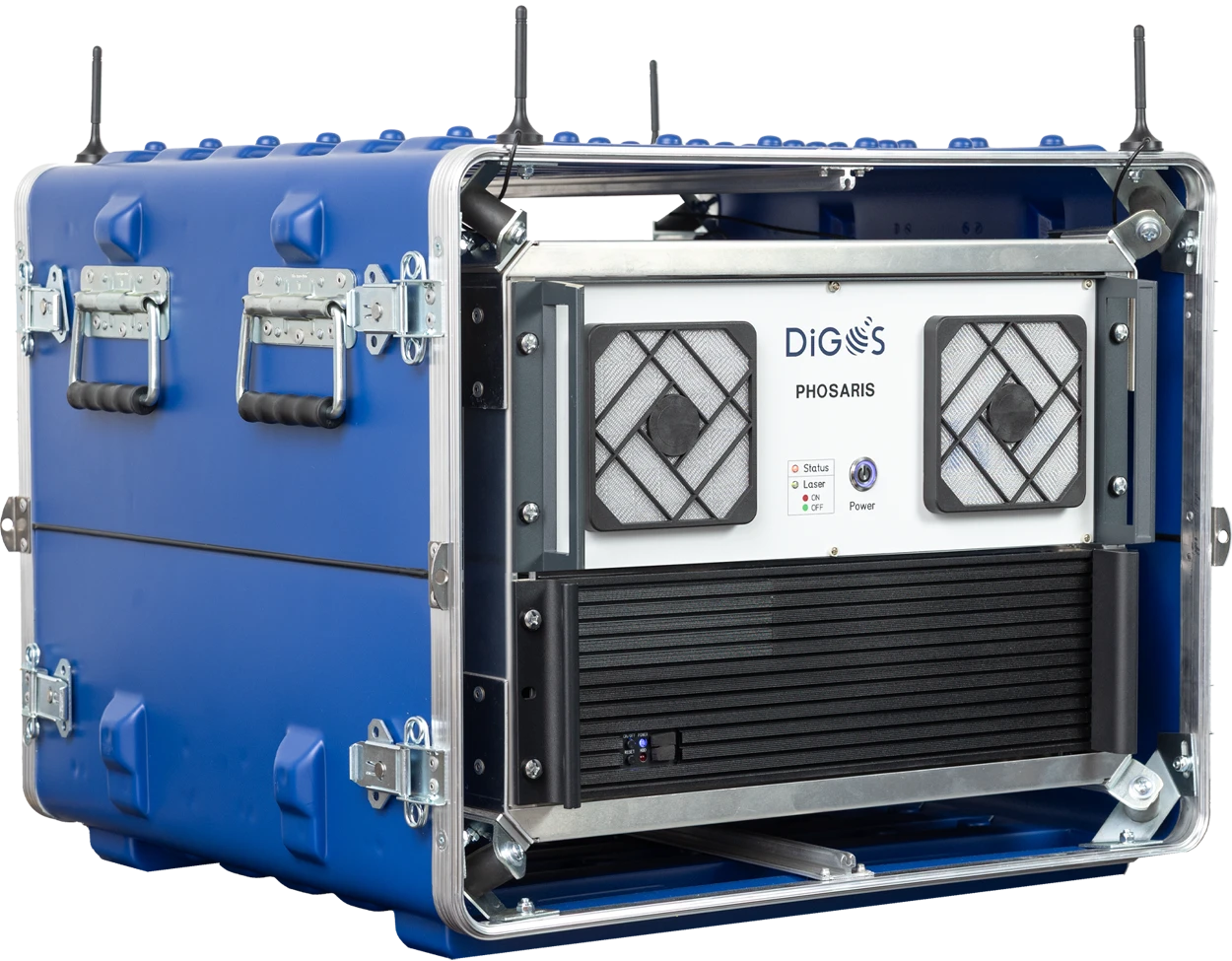
PHOSARIS turns an optical fibre into a dense line of strain sensors. Instead of measuring at only a few isolated locations, it provides continous data all along the fibre. PHOSARIS is a fibre-optic interrogator based on a patented distributed fibre-optic sensing principle.
A defining capability of PHOSARIS is its ability to follow strain changes across very different time scales: from long-term and quasi-static deformation, such as settlement or creep, to dynamic vibration and seismic signals. Distributed measurements can extend over many kilometres.
* An interrogator sends controlled light signals into an optical fibre and analyses the returned light to obtain spatially resolved measurement data.
What is Distributed Fibre Optic Sensing?
Distributed Fibre Optic Sensing (DFOS) uses an optical fibre itself as a sensor. For monitoring extended structures, ground or infrastructure, this provides a fundamentally different type of information from conventional point sensors.
While conventional sensors measure only at selected locations, DFOS transforms the deployed fibre into a continuous chain of thousands of virtual sensing positions. Changes can therefore be detected and localized along the entire fibre rather than only where an individual sensor happens to be installed.
The optical fibre itself is passive and requires no electrical power at the individual sensing locations, which is particularly advantageous for remote, inaccessible or widely distributed assets.
A practical Example: Consider a kilometre-long embankment, slope or section of ground that begins to deform locally. Conventional point sensors may miss the affected section if no sensor is installed at that location. A distributed fibre measurement continuously covers the entire instrumented length and can show where deformation begins, how far it extends and how it evolves over time. The same fibre can also capture short-lived dynamic responses caused by traffic, trains, machinery or seismic events.
How Does it Work?
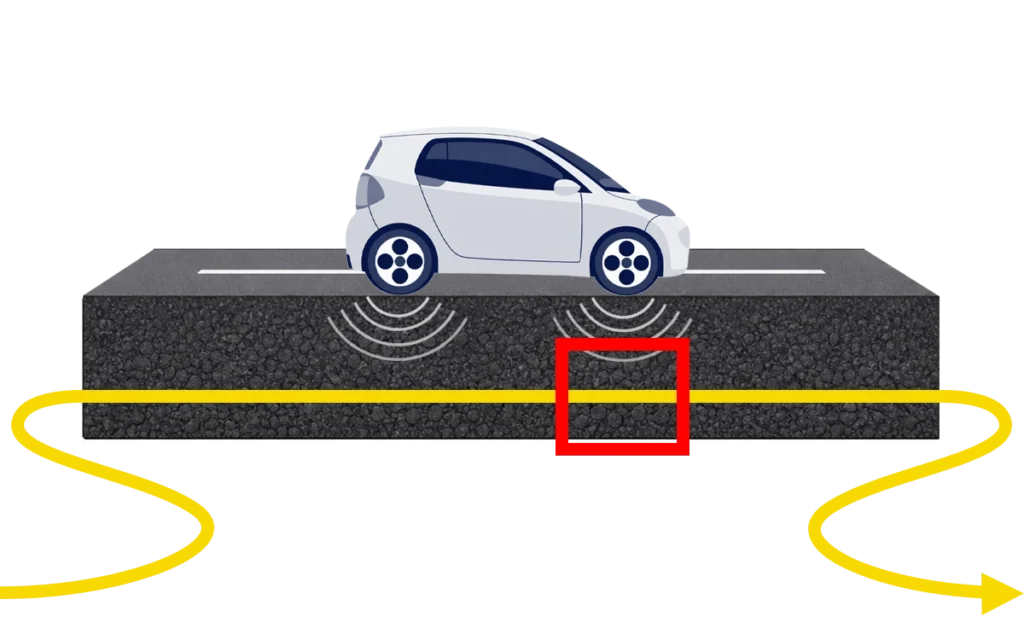
The principle is illustrated using real measurement data from a fibre installed in or alongside a road. The same measurement principle applies to fibres coupled to structures, buried in the ground, installed in boreholes or integrated into other monitored assets.
A
D
B
C
A
B
C
D
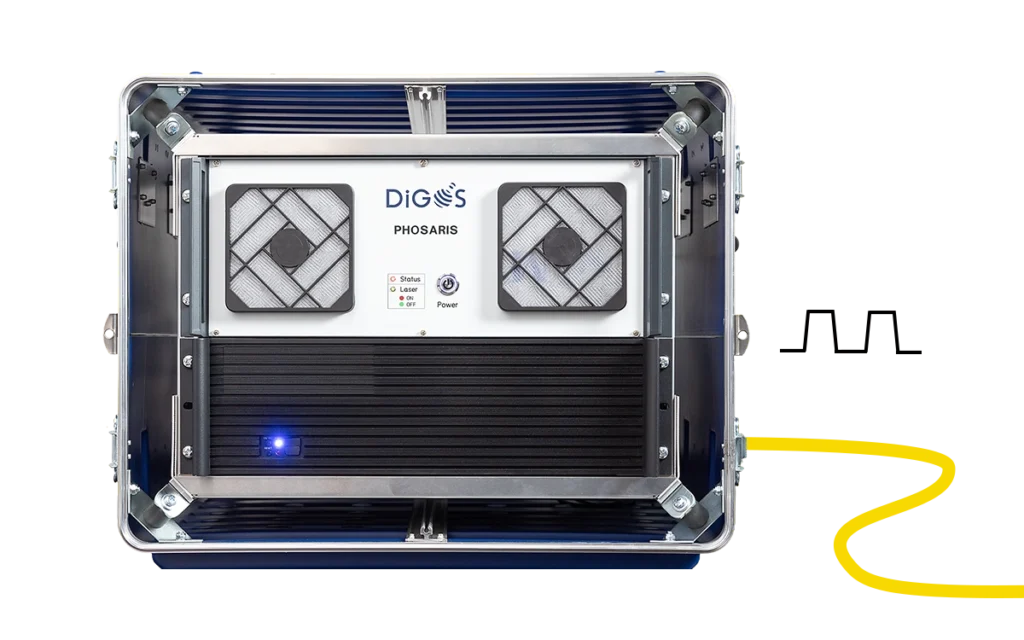
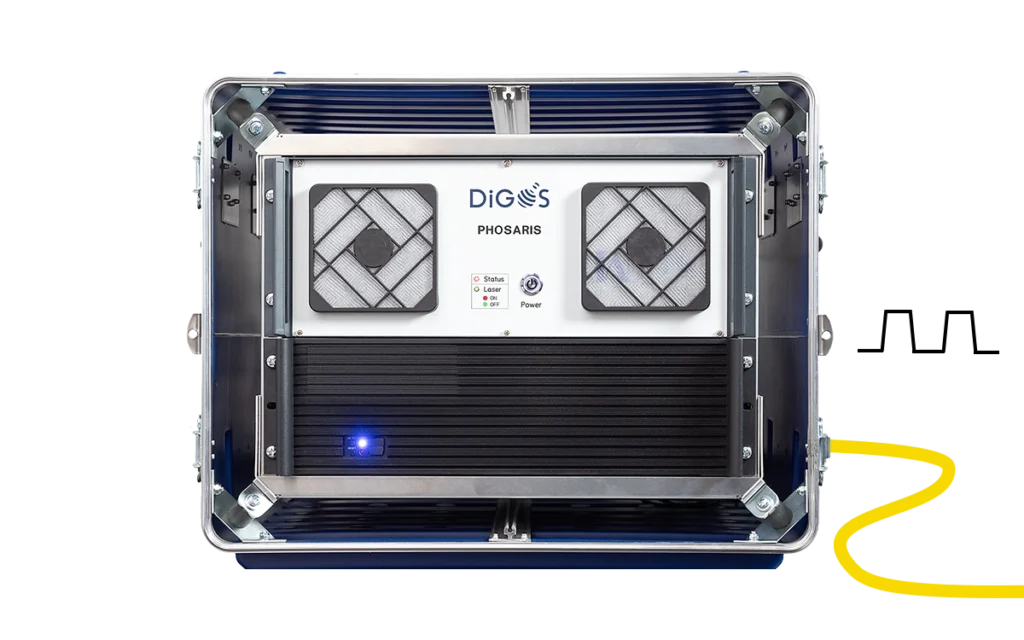
A – Send Light
PHOSARIS repeatedly sends controlled optical pulses into the sensing fibre.
B – The Fibre Responds
A passing vehicle deforms the road. The deformation is transferred to the fibre, leading to a small local axial strain change.
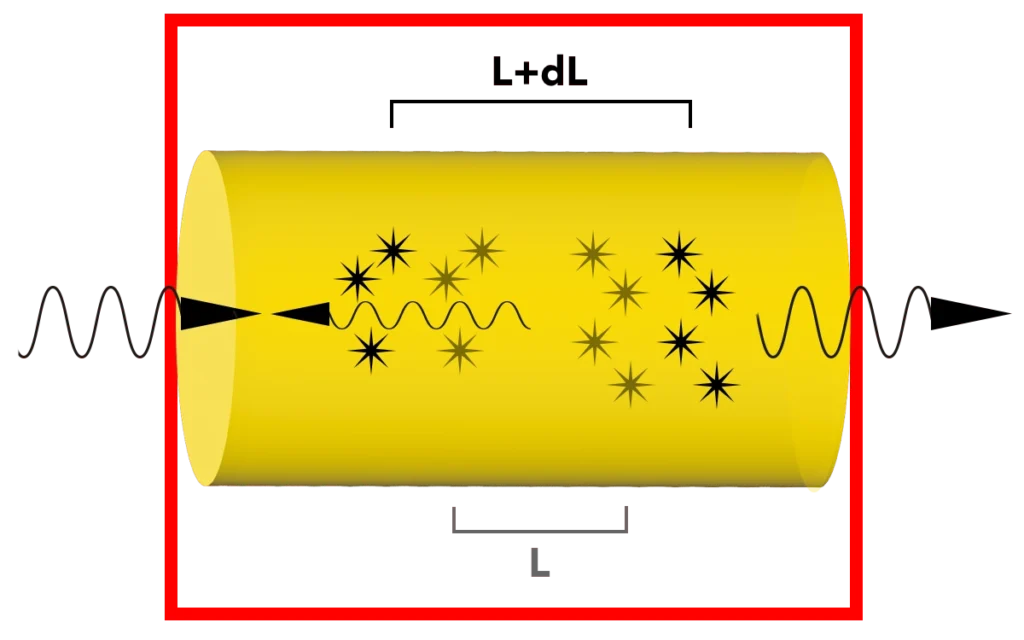
C – Light Carries the Information
Microscopic variations naturally present in the fibre core scatter a small fraction of the light back towards the interrogator. Stretching or compressing the fibre changes the local pattern of this returned light. PHOSARIS analyses these changes, while the light travel time identifies where along the fibre they occurred.
D – Distributed measurement
PHOSARIS performs this measurement continuously along the sensing fibre, providing spatially resolved information on where deformation occurs and how it changes over time. Depending on the measurement configuration, this distributed measurement can extend over kilometre-scale distances.
Measurement animation data courtesy of FOMON GmbH.
Standalone System
PHOSARIS is designed as a standalone distributed sensing system with integrated optical interrogation, data acquisition and signal processing. It can be connected directly to standard single-mode optical fibre and provides spatially resolved measurement data along the sensing fibre. Application-specific analytics, visualization and integration into existing monitoring or data-management systems can be added according to project requirements.
What Can be Measured?
PHOSARIS primarily measures distributed relative strain changes along the fibre. Depending on their origin and time scale, these measurements reveal slow deformation, dynamic structural response, vibration and seismic or acoustic signals.
Deformation & Strain
Settlement, subsidence, creep, extension and compression, structural movement, slope deformation and load- or pressure-induced strain.

Dynamic Response & Vibration
Moving vehicles and trains, machinery, structural vibration, impacts and transient loading.

Seismic & Acoustic Signals
Earthquakes, microseismicity, seismic exploration, fracture-related signals and other seismic or acoustic vibration sources.
Key Features
High-resolution measurement from long-term deformation to dynamic strain
Distributed measurement with metre-scale spatial resolution
Reference-based long-term strain tracking
Continuous or campaign-based monitoring
Standard single-mode fibre — no dedicated sensing fibre required
Consistent sensitivity along the sensing fibre
Real-time data access and integration
Typical applications
Well-Suited for Many Applications
Distributed measurements are particularly valuable when changes may occur anywhere along an extended structure, fibre route or section of ground. PHOSARIS can reveal where deformation or dynamic activity occurs, how large the affected region is and how the signal evolves over time.
This makes the technology relevant for infrastructure operators, geoscience, civil engineering, transportation and subsurface monitoring — especially where assets are difficult to access, widely distributed or require long-term observation. The same measurement capabilities can support many further applications wherever small distributed deformation or vibration must be detected over extended distances.
+
Geophysics
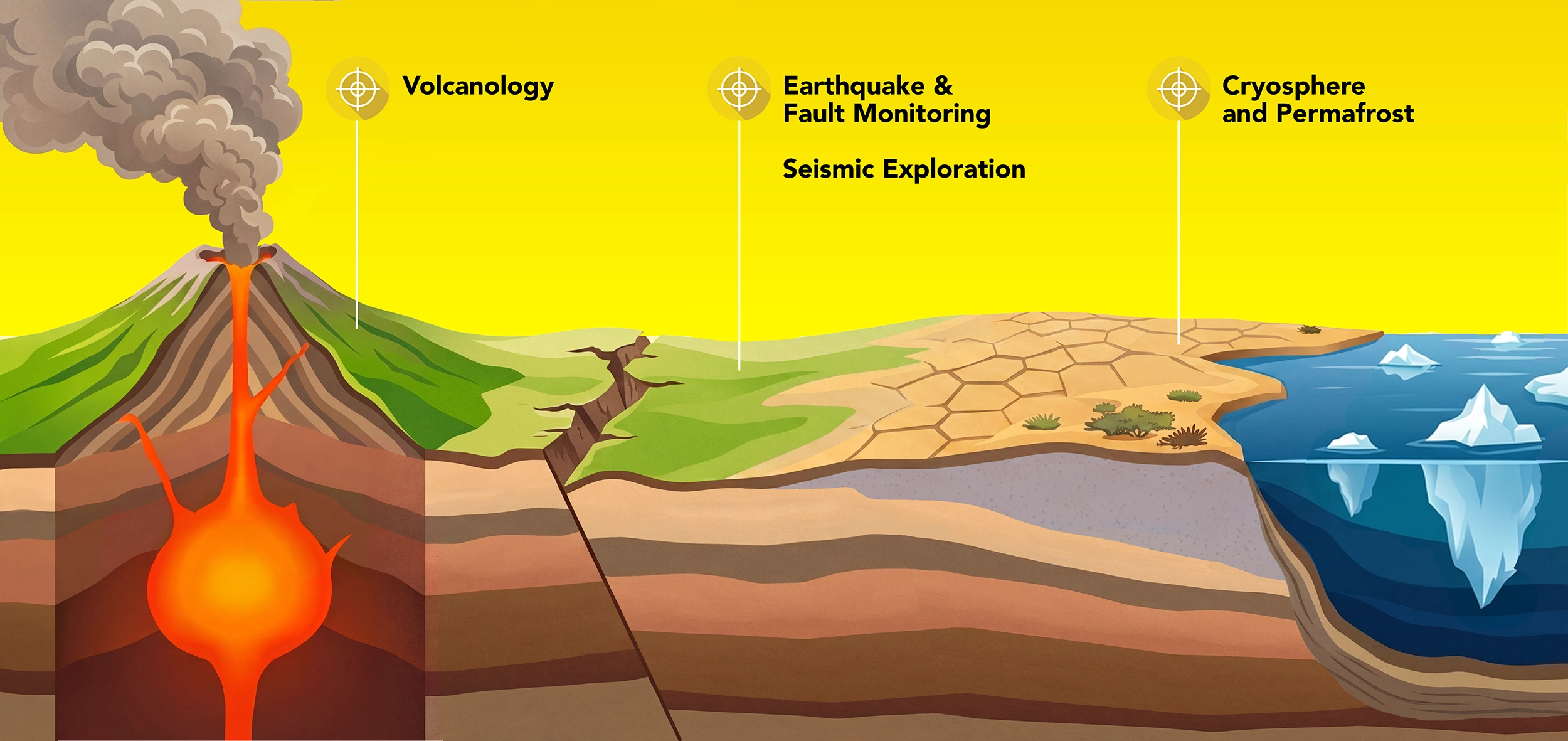
Earthquake and Fault Monitoring — distributed seismic signals together with slow tectonic or fault-related deformation.
Volcanology — long-term volcanic deformation, tremor, seismic activity and deformation associated with volcanic unrest or eruptions.
Cryosphere and Permafrost — creep, deformation, ice-related seismic signals and changing ground conditions.
Seismic exploration and Ambient-Noise Monitoring — including surface and borehole fibre configurations.
Underground and Repository Monitoring — long-term deformation and seismic activity.
+
Civil Engineering
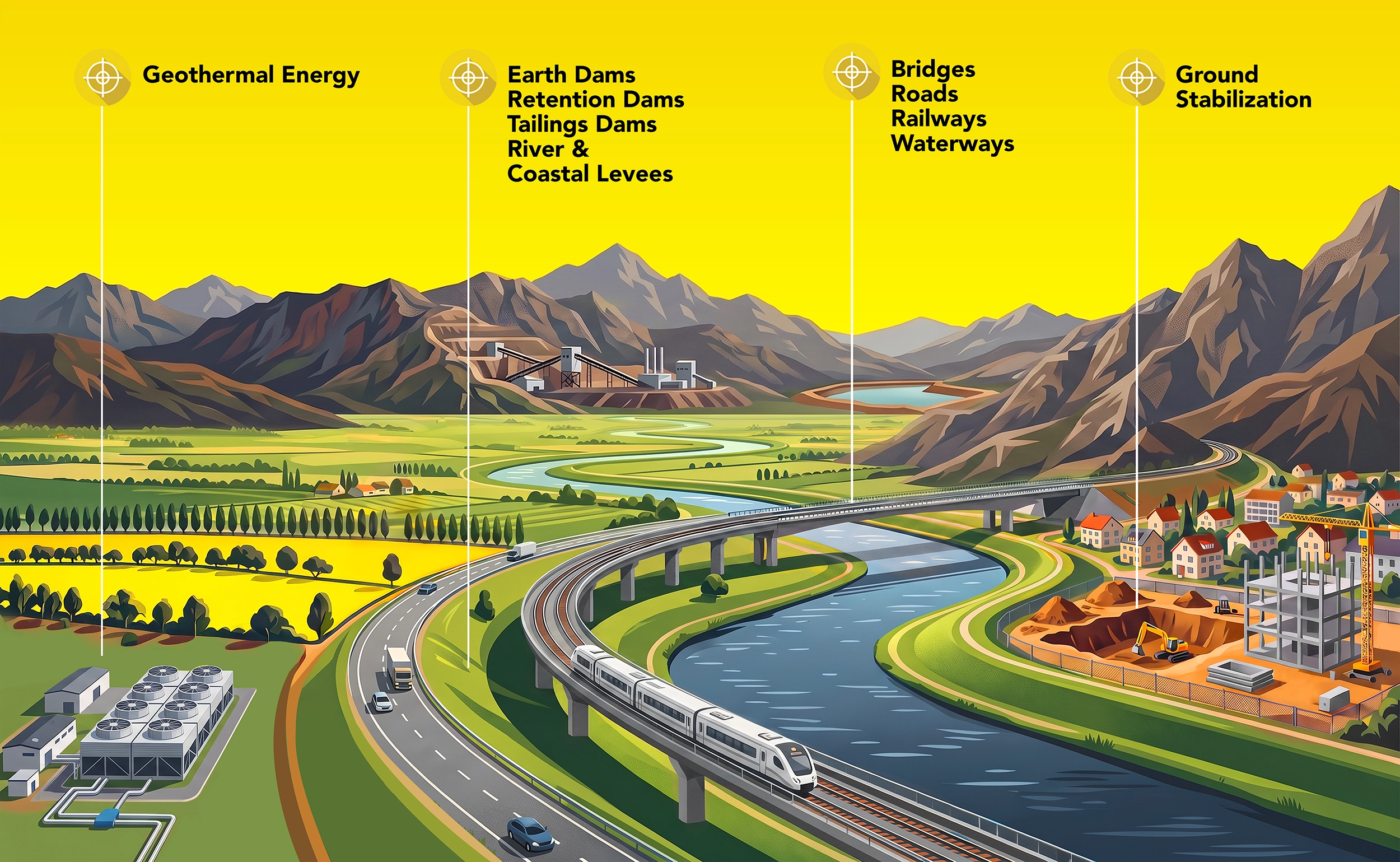
Ground and Foundation Monitoring — settlement, subsidence, compaction, pile and anchor response and excavation support.
Bridges and Large Structures — long-term deformation, load response and vibration.
Tunnels and Underground Structures — convergence, settlement, swelling, creep and dynamic response.
+
Transportation Infrastructure
Roads and Embankments — settlement, structural deformation and deterioration, together with traffic monitoring and analysis of traffic-induced dynamic signals.
Railways — track and subgrade deformation, train-induced dynamic response and infrastructure condition.
Ports and Waterways — quay walls, locks, bank structures and long-term settlement or deformation.
+
Earth Structures & Mining
Slopes and Landslides — creep, progressive deformation and seismic or microseismic activity.
Embankments, Dams and Levees — settlement, deformation and dynamic loading.
Tailings Dams and Mining Structures — distributed deformation and stability monitoring.
Underground Mining and Rock Mechanics — convergence, subsidence, rock-mass deformation, excavation response and microseismic activity.
+
Energy Infrastructure
Geothermal and Borehole Monitoring — deformation, geomechanical response and seismic activity.
Underground Storage and CCS — strain, geomechanical changes and microseismicity.
Pipelines, Caverns and Underground Assets — structural deformation and dynamic events where suitable fibre coupling is available.
+++
We Welcome Your Application Challenges!
Many further applications are possible wherever small spatially distributed deformation or vibration must be detected over extended distances. We welcome new application challenges and pilot projects.
Why PHOSARIS
We Make the Difference
High-Resolution Measurement of Slow Deformation
PHOSARIS is designed to follow very slow and quasi-static strain changes such as settlement, creep, ground movement and evolving structural deformation. Nanometre-per-metre-scale strain sensitivity makes very small changes observable along the sensing fibre.
Reliable Long-Term Monitoring
Infrastructure and geotechnical assets often change gradually before visible damage occurs. Continuous distributed measurements provide spatial and temporal information that can reveal evolving deformation, support condition assessment and help operators focus inspection and maintenance where it is most needed. PHOSARIS data can be integrated into automated monitoring, visualization and early-warning workflows.
Continuous Coverage Along Extended Assets
Conventional strain gauges, extensometers, geophones and other point sensors provide information at selected locations. A distributed fibre measurement provides closely spaced sensing positions along the complete instrumented fibre, making localized changes visible even when their location was not known in advance.
No Dedicated Sensing Cables are Required
PHOSARIS operates with standard single-mode optical fibre; a dedicated optical sensing fibre is not required. Where suitable unused fibres already exist, for example in telecommunications infrastructure, they can potentially be repurposed for sensing. The quality of strain measurement depends on how effectively the cable installation transfers deformation from the monitored ground or structure into the fibre. Reusing existing fibre can substantially reduce installation effort and cost.
One Fibre Across Time Scales
PHOSARIS follows the same sensing fibre across very different time scales — from slow and quasi-static deformation to dynamic vibration and seismic signals. This allows long-term trends and short-lived events to be examined within one distributed sensing platform rather than treating them as completely separate measurement tasks.
The combination of reference-based long-term strain tracking, nanometre-per-metre-scale sensitivity and kilohertz-range dynamic measurement is a defining capability of PHOSARIS.
Specifications
Preliminary Datasheet
PHOSARIS can be configured for different sensing ranges, spatial resolutions and temporal bandwidths. The values below describe preliminary system capabilities; achievable performance depends on the measurement configuration, fibre length, optical attenuation, spatial resolution and evaluation settings. Maximum values are not necessarily achieved simultaneously. Final specifications will be published following product validation.
Sensing Performance
Parameter
Specification
Comment
Optical sensing ports
2 standard
One sensing port active at a time
Spatial channel spacing
≥ 0.4 m
Configurable
Spatial resolution
≥ 1 m
Configurable
Measurement repetition rate
Up to 5 kHz ª
Dependent on sensing range and measurement configuration
Measurement bandwidth
Quasi-static / DC to 2.5 kHz
Upper bandwidth depends on measurement repetition rate and configuration. Long-term / near-DC performance depends additionally on fibre installation and environmental stability.
Long-term measurement principle
Reference-based relative strain tracking
Long-term correlation and stability depend on fibre installation and local environmental conditions; reference states can be updated where required
Strain sensitivity / noise floor
Preliminary: < 1 nε under specified measurement conditions
Current reference condition: 5 m evaluation / gauge length
Primary measurand
Relative axial strain change Δε.
–
ª Depending on measurement settings, fibre length, and application: recommendation e.g. 1 kHz for 2 km sensor length
Optical Interface
Parameter
Specification
Comment
Optical connector
E2000/APC standard
Alternative connector options available on request
Single-ended operation
Yes
–
Compatible fibers
Standard single-mode optical fibre
Multimode fibres with limitations
Timing & Synchronization
Parameter
Specification
Comment
Synchronization
GPS / PTP / 1PPS
Selectable & Configurable
Further information available upon request.
Mechanical & Power Specifications
Parameter
Specification
Comment
Form factor
19″ 4U PHOSARIS interrogator + 3U measurement / processing PC
–
Transport case dimensions (W × H × D)
Approx. 790 × 630 × 505 mm
–
Transport weight
Approx. 30 kg including transport container
–
Power supply
230 VAC, 50/60 Hz
–
Preliminary product information. Specifications and product features are subject to change without notice as part of ongoing development and validation. Performance values depend on the measurement configuration, fibre length, optical attenuation, spatial resolution settings. Maximum values are not necessarily achievable simultaneously. This document is provided for information purposes only.
Awarded Technology
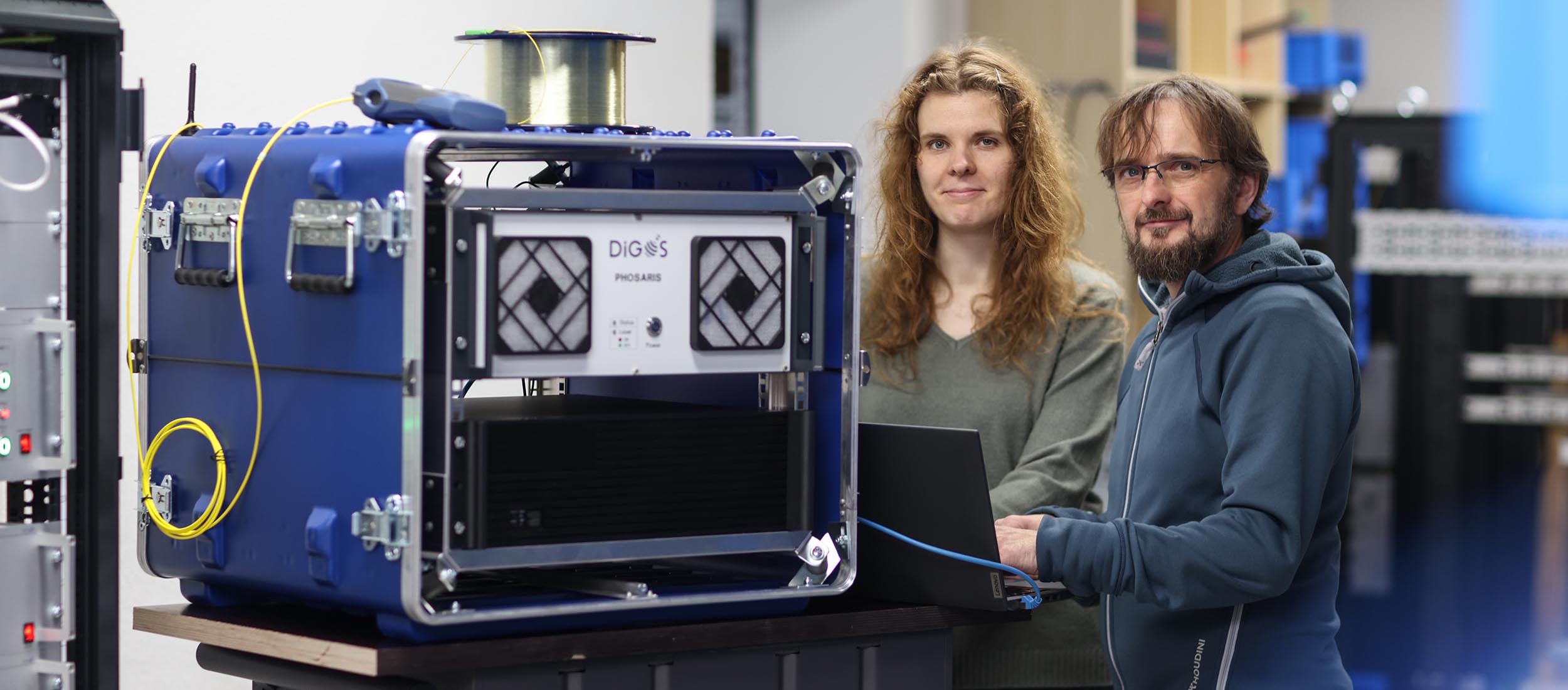
In 2025, DiGOS was awarded the Berlin-Brandenburg Innovation Prize for Phosaris. From the laudation:
“DiGOS is recognized as a company rooted in the state of Brandenburg and for an innovation that demonstrates how research and industry can work hand in hand. With its innovation ‘Fibre-optic sensing for resilient infrastructure and environmental monitoring,’ DiGOS Potsdam has made a significant contribution to the safety of our infrastructure.”
Yes, …
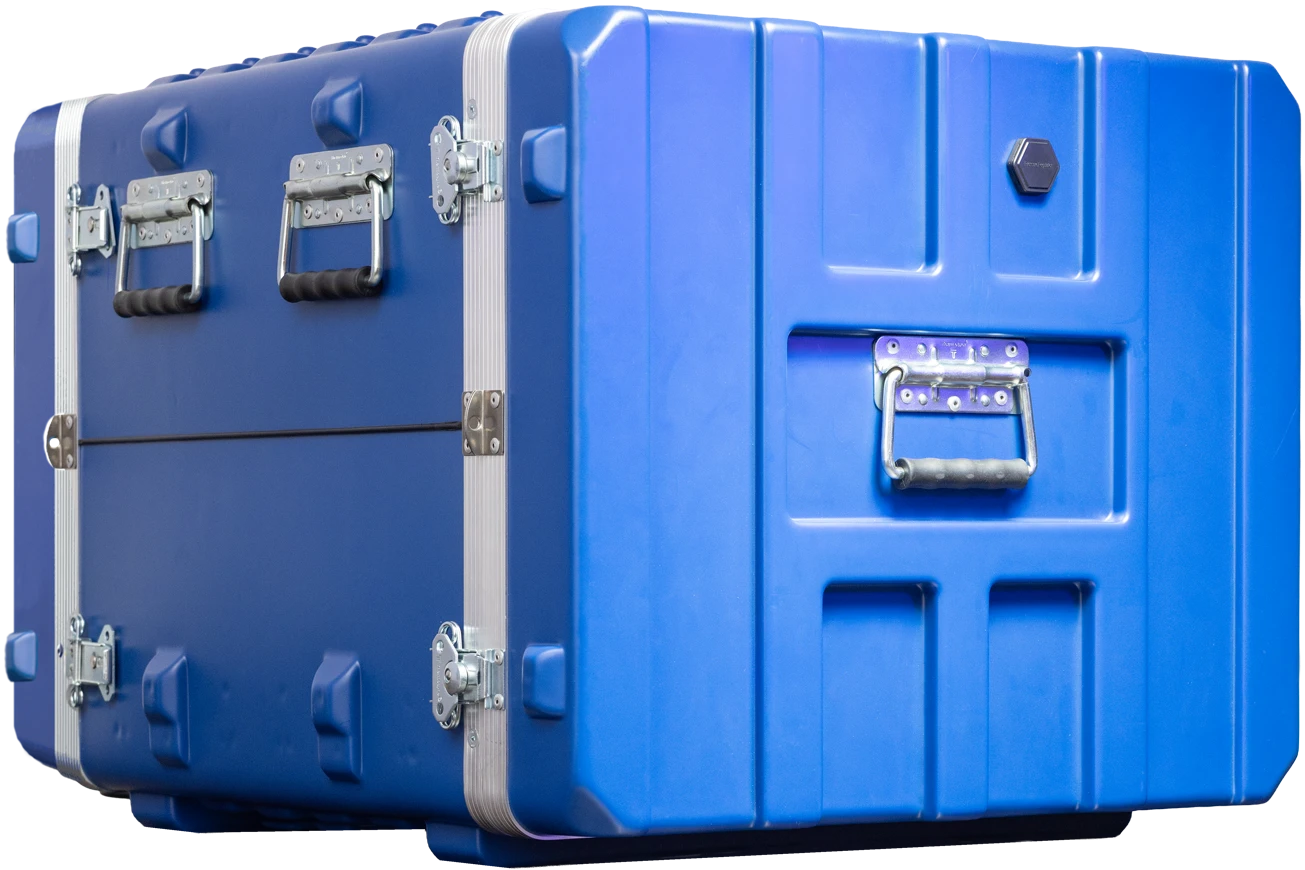
… it’s mobile!
PHOSARIS performance has been demonstrated in pilot applications. It‘s time to start the roll-out! We are actively looking for users & partners with challenging monitoring applications and welcome enquiries from both established and emerging fields.